How to choose
Which pan to buy first, and which three you actually need
Hob type, diameter and the cooking you really do decide the first pan. A four-material comparison, with the sizes that match Canadian burners and ovens.
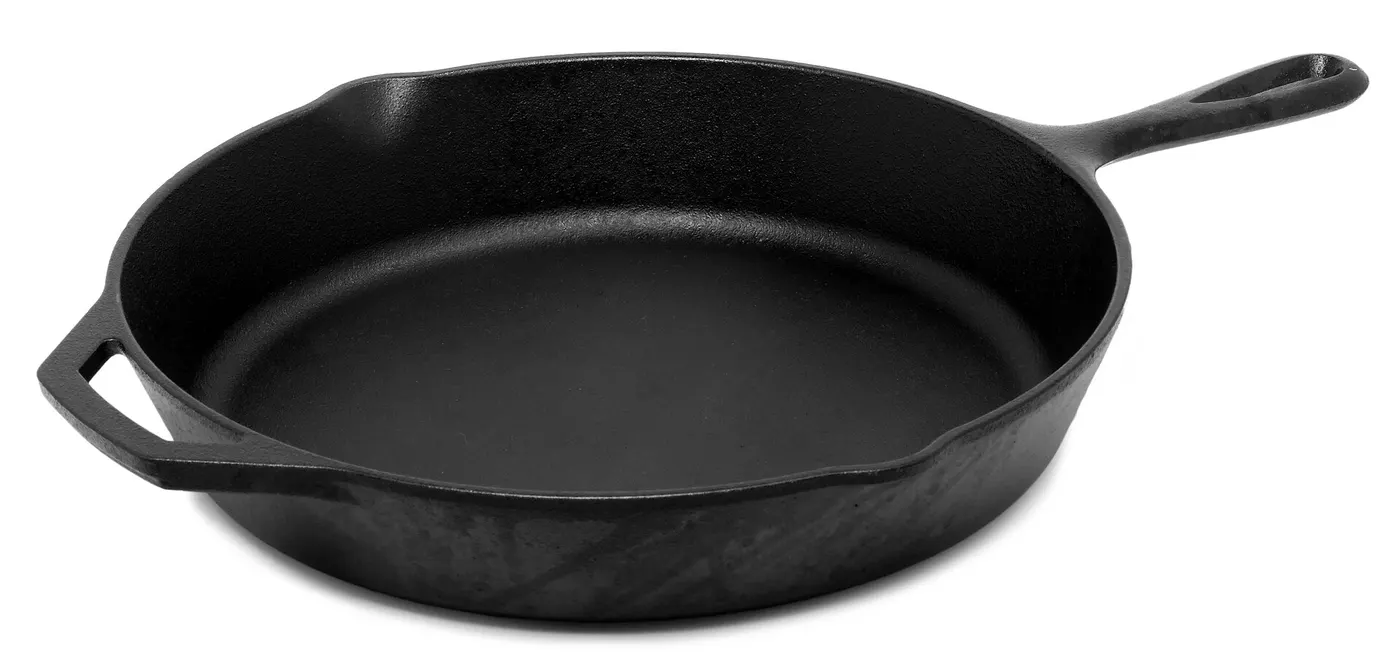
Most kitchens contain more pans than they use and fewer of the right ones. The cause is nearly always buying a set, because a set is priced as one decision when it is really eight, and the two or three pieces you would have chosen are subsidising five you will not touch.
This guide takes the decision in the order that actually constrains it: the hob you own, the diameter that matches your burners and your household, then the material. Every price below is an example used to make the arithmetic visible; this site publishes no live prices and has tested no cookware.
Advertisement
Start from the hob, not from the pan
An induction hob works by inducing a current in the base of the pan, so the base has to be ferrous. A magnet that sticks firmly to the underside is the whole test, and it takes about 5 seconds in a shop. Plain aluminium, copper and most glass or ceramic cookware will sit on an induction hob doing nothing at all.
Gas and electric coil hobs heat the pan from outside, so the base material matters less and base flatness matters more. A warped base on a coil hob loses contact across the middle and cooks in a ring; the same pan on gas is merely inefficient. On a smooth ceramic hob, a rough cast base can scratch the glass, which is a repair rather than an annoyance.
Oven transfer is the second constraint and it is set by the handle, not the pan. A riveted metal handle goes in the oven; a moulded plastic one usually does not past a stated temperature, and a wooden one never does. If the cooking you like starts on the hob and finishes in the oven, this single detail removes about half the shortlist before material is even discussed.
| Hob type | Base requirement | What goes wrong with the wrong pan |
|---|---|---|
| Induction | Ferrous base a magnet grips | Nothing heats at all |
| Smooth ceramic or halogen | Flat, smooth base | Rough cast bases scratch the glass |
| Electric coil | Flat base, good contact | A warped base cooks in a ring |
| Gas | Any material; base size near burner size | An oversized pan heats only its centre |
The magnet test is the only one you can run in a shop in 5 seconds. Everything else is read off the base or the handle.
Four materials, four jobs
Bare cast iron holds heat better than anything else at this price and gives up a flat sear that lighter pans cannot match. In exchange it wants drying after every wash and a thin wipe of oil, it is heavy enough to matter when you are tipping it, and acidic sauces will strip the seasoning if they sit in it.
Enamelled cast iron removes the seasoning routine and adds a glass surface, which is why it suits braises, stews and anything with tomato or wine in it. The trade is chipping: a knock against a tap or a sink edge takes a flake of enamel off, and that is permanent. It is also roughly three to four times the price of the bare version at the example prices used here.
Tri-ply stainless is the generalist. It browns well, takes any utensil, goes in the dishwasher and in the oven, and it never needs seasoning. It sticks more than non-stick and conducts less evenly than copper, and both of those are acceptable trades for a pan that will still be the same pan in 2038. Non-stick is the specialist: eggs, pancakes, fish. Its coating wears, which is why the costs guide on this site puts it at the most expensive pan per meal despite the lowest shelf price.
| Material | Example price | Best at | Main trade |
|---|---|---|---|
| Bare cast iron | $45 | Searing, oven finishing, bread | Dry and oil after every wash |
| Enamelled cast iron | $160 | Braising, acidic sauces, serving | Enamel chips if knocked |
| Tri-ply stainless | $110 | Everyday browning, sauces, dishwasher | Sticks more than non-stick |
| Non-stick | $45 | Eggs, pancakes, delicate fish | Coating wears, so it is replaced |
Example prices chosen to show the arithmetic, not quotations. Shelf prices in Canada exclude GST/HST, which is added at the till.
Diameter is a cooking decision, not a preference
A pan that is too large for the burner heats in its middle and steams at its edges; a pan that is too small for the food steams everything. Measure the burner, then measure what you cook: two chicken breasts need about 24 cm of clear base, four need about 28 cm, and crowding them is why home-browned meat so often turns grey.
For most Canadian households one 26 cm frying pan is the right first purchase, because it covers two to four portions and still fits a standard burner and a standard oven shelf. A 20 cm pan is a second pan for eggs, not a first pan for anything. Above 30 cm the pan stops fitting most ovens and most sinks, which matters more in practice than the extra capacity.
Depth decides the other two pieces. A 24 cm saucepan of about 3 L handles pasta for three and most sauces; a 5 L casserole or Dutch oven handles a braise for four to six and doubles as the bread pot. Those three vessels, in those three sizes, cover roughly 90% of what a home kitchen does in a week.
- 20 cm frying pan: 1 to 2 eggs, a single portion, a small omelette
- 26 cm frying pan: 2 to 4 portions, fits a standard burner and oven shelf, the sensible first pan
- 30 cm frying pan: 4 to 6 portions, often too wide for a single burner and for some ovens
- 24 cm saucepan, about 3 L: pasta for 3, rice, sauces, blanching
- 5 L casserole or Dutch oven: braises for 4 to 6, stock, no-knead bread
Buy the set last, if at all
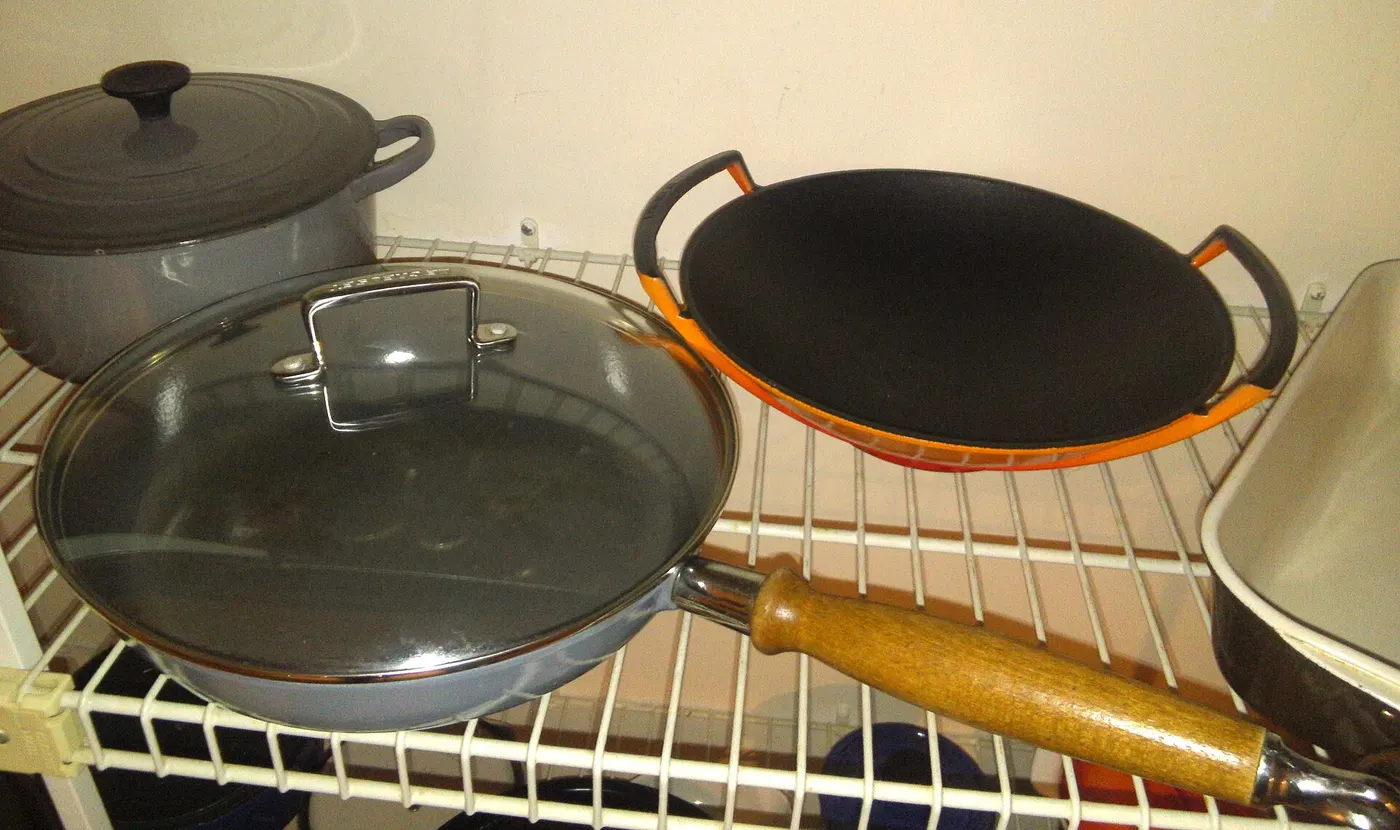
A five-piece set at an example $400 looks like a saving against three separately chosen pieces at $45, $110 and $280, which come to $435. It is a saving of $35, about 8%, in exchange for two pieces chosen by somebody who has never seen your hob. If either of those two is the wrong diameter, the set is the more expensive option.
Sets are also where lids hide the cost. A matching lid is worth having on the casserole and the saucepan and is nearly useless on the frying pan, yet it is counted as a piece. Read the piece count as vessels plus lids and the five-piece set is often three vessels.
Where a set genuinely wins is the first kitchen with nothing in it, because the alternative is buying everything at full price in one week. Even then, check that each vessel passes the magnet test if you have induction, and that at least one handle is oven-safe.
| Option | What you get | Example price |
|---|---|---|
| Chosen separately | 26 cm cast iron pan, 24 cm tri-ply saucepan, 5 L enamelled casserole | $435 |
| Five-piece set | Three vessels and two lids, sizes decided by the maker | $400 |
| Difference | $35, about 8%, against sizes you did not choose | — |
Example prices. The $435 figure is $45 plus $110 plus $280, the same unit prices used in the costs guide on this site.
What the shelf price leaves out
Canadian shelf labels exclude sales tax. On $435 of cookware the Canada Revenue Agency's rate table gives $21.75 at the 5% rate in Alberta, British Columbia, Manitoba, the territories, Quebec and Saskatchewan, and $56.55 in Ontario at 13%. In New Brunswick, Newfoundland and Labrador and Prince Edward Island at 15% it is $65.25, and in Nova Scotia at 14% since 1 April 2025 it is $60.90.
Advertised prices have to be attainable. The Competition Bureau treats drip pricing, where a price is not reachable because of fixed obligatory charges, as a false or misleading representation, with an exception only for charges imposed by an Act of Parliament or a legislature, such as sales tax. A mandatory delivery or assembly fee belongs in the advertised price; GST/HST does not have to be.
Performance claims carry their own rule. Under the Competition Act a claim about a product's performance, effectiveness or length of life must be based on an adequate and proper test, so a lifetime warranty and a claimed heat distribution are different kinds of statement. The one you can act on is the warranty, because it names a remedy.
Before you buy
- Identify your hob type and carry a fridge magnet if it is induction
- Measure the burner diameter before deciding the pan diameter
- Decide whether the pan has to go in the oven, then read the handle rather than the pan
- Count how many portions you cook at once and size the base for them, not for the recipe
- Price three chosen pieces against the set before accepting the set's saving
- Add GST/HST at your province's rate before comparing a shelf price with an online one
- Check that a lid is genuinely wanted on each piece rather than counted as one
Questions readers ask
- How do I know a pan will work on my induction hob?
- Hold a fridge magnet against the underside. If it grips firmly the base is ferrous and the hob will heat it; if it slides off or holds weakly, it will not work properly. Cast iron and most tri-ply stainless pass. Plain aluminium, copper and ceramic do not, whatever the packaging says about compatibility.
- Is enamelled cast iron worth three times the price of bare cast iron?
- It depends on what you cook rather than on the pan. Enamel is worth the gap if tomato, wine or vinegar sit in the pan for an hour at a time, because those strip seasoning from bare iron. At the example prices the enamelled pan costs about 6 cents a meal across 12 years against about 2 cents for the bare one, so the gap is real but small per meal.
- What size frying pan should I buy if I can only buy one?
- 26 cm. It takes two to four portions without crowding, fits a standard burner and a standard oven shelf, and still goes in a domestic sink. A 20 cm pan is a second pan for eggs and a 30 cm pan often overhangs the burner, heating its centre while its edges steam whatever you put there.
- Do I need a lid for the frying pan?
- Rarely, and it is usually the piece that pads a set's count. Lids earn their place on the saucepan and the casserole, where you are holding a simmer or a braise for 30 to 90 minutes. On a frying pan a lid mostly traps steam and undoes the browning you bought the pan for, so a flat universal lid is enough if you want one at all.
- Is a set ever the right purchase?
- For a first kitchen with nothing in it, yes, because the alternative is buying everything at full price in one week. Check two things before paying: that every vessel passes the magnet test if your hob is induction, and that at least one handle is oven-safe. At the example prices the set saves $35 against three chosen pieces, which is about 8%.
Sources
- Canada Revenue Agency — GST/HST rate by province and territory — checked 2026-11-03
- Competition Bureau Canada — Misleading representations and deceptive marketing practices — checked 2026-11-03
- Competition Bureau Canada — Drip pricing and unattainable prices — checked 2026-11-03
Some links on this site can earn us a commission. That does not change which product a guide recommends, and it adds nothing to your price.